Balcony solar power systems can provide useful solar electricity, but the biggest question is how this energy is used. Some systems feed electricity directly into household appliances as long as the sun is shining. Others include storage so that unused electricity is available later. Comparing balcony solar storage with direct solar use helps clarify which configuration allows for better self-consumption, greater convenience, and higher savings. The right choice largely depends on when your household uses electricity. Daytime routines often favor direct use, while a predominantly evening electricity demand is more likely to benefit from storing excess solar production and using it after sunset.
How does direct solar energy use work in balcony power plants?
Immediate use of solar energy during production times
Direct solar use means that your balcony solar system supplies electricity to your household appliances as soon as the modules generate it. During sunny hours, household appliances already in use can utilize this solar energy first, thus reducing the amount of electricity drawn from the grid. This concept works best with a consistent daily demand, such as from routers, refrigerators, laptops, or other continuous consumers. If solar production matches current consumption, self-consumption remains high, and very little energy is wasted. However, if the module output exceeds the current household consumption, the excess electricity is typically fed into the grid or curtailed, depending on the system design and local regulations for small, plug-and-play solar systems.
Advantages and limitations of direct solar energy use
The main advantage of direct solar consumption is its simplicity. Without a battery, the system is easier to install, generally less expensive, and requires fewer components to monitor. Direct use also avoids storage losses, as the electricity flows directly from generation to consumption. For households with regular daytime activity, a balcony solar system can therefore be very efficient in practice. The limitation lies in the timing. Solar generation peaks around midday, but many households consume more electricity in the morning or evening. When no one is home and there is only minimal standby power consumption, a significant portion of the solar energy can contribute little to meeting household needs. This reduces self-consumption and practical savings over time.
How does a storage system change the use of solar energy on the balcony?
Storing excess solar energy for later use
Storage alters energy consumption patterns by capturing excess solar power instead of letting it flow unused during periods of low demand. When production exceeds current consumption, the battery charges. Later, when solar power decreases or ceases altogether, the stored energy can power household appliances. This makes a balcony solar system more flexible because solar power is no longer limited to sunny production times. In practical terms, storage helps shift midday power generation to the evening, when the demand for lighting, supplemental cooking appliances, entertainment electronics, and chargers often increases. While the battery does incur conversion losses and additional costs, it gives the system a time-shifting capability that direct use during normal daytime operation cannot provide.
Improving self-consumption through stored energy
A battery storage system improves self-consumption because more of the electricity generated on the balcony remains available in the household. Instead of relying solely on current production, the household can use solar energy after sunset or during cloudy periods. This is particularly valuable when electricity demand is low during the day, but total daily consumption remains significant. Stored energy reduces grid reliance during periods of higher consumption and can make the overall contribution of the solar system more consistent. This is most beneficial for households with predictable evening loads. While a storage system doesn’t increase the electricity production of the modules, it does increase the proportion of generated energy that is used effectively in the household, often making a balcony solar system considerably more practical for everyday use.
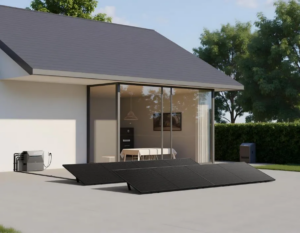
Comparison of storage and direct use for different household needs
Which option is better suited to users with daily energy consumption?
Direct use is generally a better fit for daytime energy consumers. If someone works from home, runs office equipment, cooks lunch at home, or regularly uses appliances while the panels are generating electricity, immediate solar consumption can cover a significant portion of their daily needs. In this situation, the simplicity and lower initial costs of a battery-free balcony solar system are strong advantages. You benefit from solar power precisely when it’s available, without having to pay extra for shifting energy that may not even be necessary. While storage systems still offer flexible reserves for load shifting, they are often less important if daytime self-consumption is already high. For households with consistent midday consumption, direct solar use is usually the more efficient and practical choice.
Which option benefits households with energy needs in the evening?
Households with higher electricity demand in the evening generally benefit more from storage solutions. When the majority of electricity consumption occurs after work, a large portion of the solar energy generated during the day goes unused because it doesn’t match the household’s actual needs. A battery storage system resolves this imbalance by making surplus energy available for later use. This allows lighting, internet devices, televisions, device charging, and other typical evening loads to be powered by solar energy generated earlier in the day. As a result, stored energy in such households often increases self-consumption rates significantly more than direct consumption alone. While the system becomes more complex and expensive, the added flexibility better aligns with real-world lifestyles. For evening-centric routines, a solar power system with storage is therefore the more sensible option.
Conclusion
Balcony solar power systems with storage and direct solar use cater to different usage patterns, and the better choice becomes clear when considering the household’s daily energy needs. Direct use works best for households with consistent daily consumption and a preference for lower system costs and simplicity. Storage is best suited for households that require more electricity in the evening and want to maximize self-consumption from limited solar production. If your goal is immediate, hassle-free savings, direct use is a strong option. If your goal is greater flexibility and more usable solar energy throughout the day, storage offers the clear advantage.

Hallo! Ich bin Gourav Singh, Gründer von PromiTrend.de – Dein Puls für die Welt der Stars und Trends. Meine Leidenschaft ist es, spannende Geschichten und aktuelle News aus der Welt der Promis und Trends auf den Punkt zu bringen. Mit einem Fokus auf gründliche Recherche und authentische Inhalte sorge ich dafür, dass unsere Leser immer bestens informiert sind.
Wenn ich nicht gerade über die neuesten Stars und Hypes schreibe, experimentiere ich mit kreativen Ideen, um PromiTrend.de noch besser zu machen.
Bleib dran – die nächste spannende Story wartet schon!